Tailored user forum for hospital customers

Tailored user forum for hospital customers
User forum with the hospitals

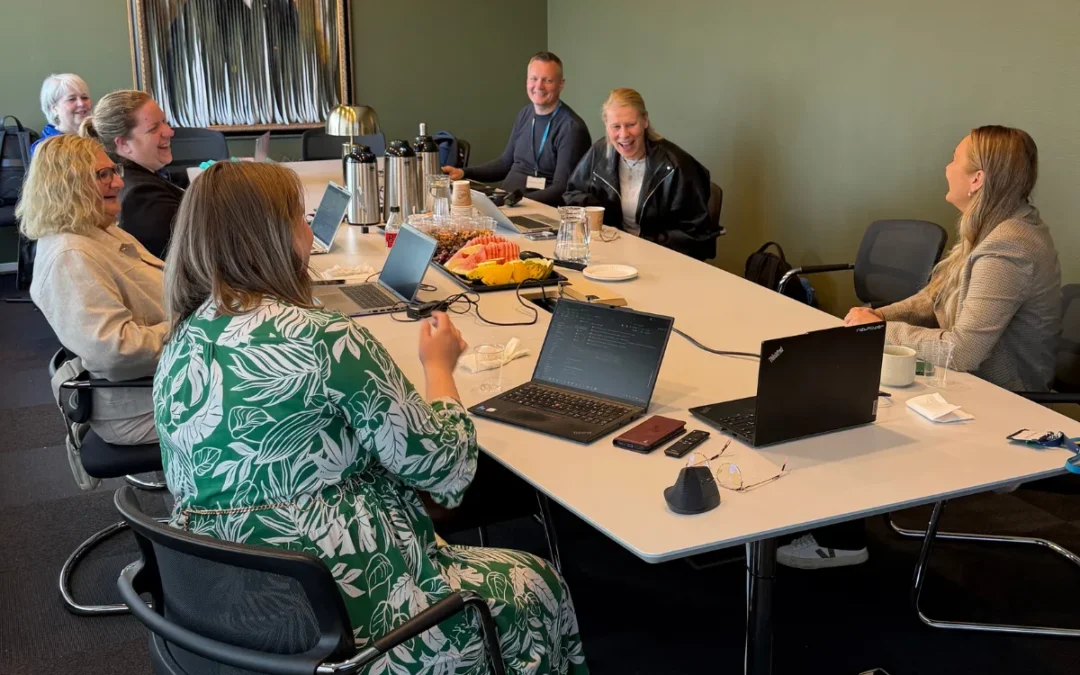
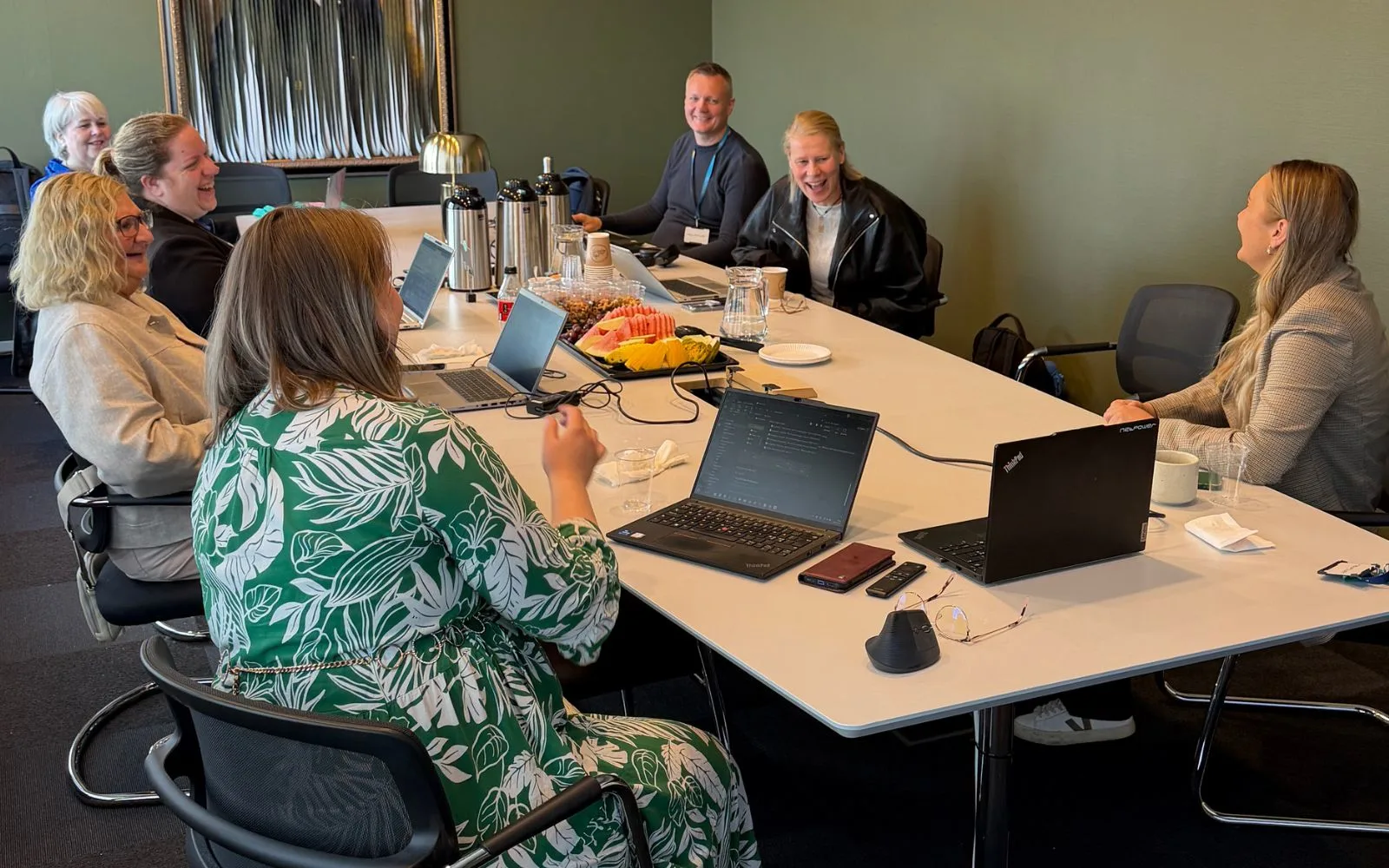
Representatives from some of the hospitals and the Certain team.

In September we brought together several of our hospital customers for a two-day user forum, including Oslo University Hospital, Vestre Viken and Lovisenberg. Some participants attended in person, whilst others followed the forum digitally. The goal was to create a meeting place for knowledge sharing, professional discussions and involvement in the further development of Certain QMS.

A meeting place for knowledge sharing and collaborative development

When organisations from the same sector come together, they have the opportunity to discuss challenges with others who face many of the same issues. Even though the hospitals have different routines and organise their work differently, there is much they can learn from one another.

Several of our customers have been with us since the early years of Certain QMS and have played an important role in the development of the solution. Through this type of gathering, we also gain better insight into how the system functions in practice, what needs exist and what is important going forward.

The user forum had three overarching objectives:

  • Knowledge sharing: Participants had the opportunity to share experiences, discuss common challenges and hear how others work.
  • Development: We presented what is new in the system and what we are working on going forward.
  • Influence: Participants were able to share input on what is working well, what can be improved and what needs they have within the system.

Professional content tailored to the hospitals' working day

The programme was put together based on topics and needs that have emerged through customer follow-up, as well as what we are working on in Certain QMS.

Part of the programme focused on process work. Here, participants were able to test how we can assist with advisory services in process work, drawing on their own processes and challenges.

We also presented new features in the checklist module and the new document module. Participants were able to see what is in place today and what we are working on going forward, whilst also having the opportunity to share input on functionality and their own needs.

Metatags were also on the agenda. Experiences were shared on how metatags are currently structured and used, and we discussed different approaches to setting them up.

The programme was structured so that participants could invite relevant specialists to the sessions most relevant to them. This allowed the right people to take part in the discussions, without everyone having to attend the full programme.

Social evening

After the professional programme, those attending in person gathered for dinner. It was a pleasant end to the day, with time to continue conversations and get to know one another across organisations.

We will take the input and experiences from the user forum forward in the development of Certain QMS. At the same time, we want to continue with this type of gathering, where customers can meet, share experiences and contribute input to what we are working on.

Oda Hjelmeland

Oda Hjelmeland

Digital Marketer

Produces content for Certain QMS and works closely with our subject matter experts to communicate insights on quality management, HSE and management systems. She develops targeted content that makes specialist knowledge accessible, relevant and applicable in practice.

Management review: from ISO requirement to strategic management tool

Management review: from ISO requirement to strategic management tool

Management review

Many organisations associate the management review primarily with a requirement in the ISO standards. But organisations that derive the greatest value from the process see it as far more than a mandatory activity before an audit. When the management review is used correctly, it becomes a strategic tool that helps leadership evaluate the organisation’s direction, identify risks and ensure continual improvement.

Here we take a closer look at what a management review is, why it matters, and how organisations can carry out the process effectively with the help of a digital management system such as Certain QMS.

What is a management review?

A management review (also referred to as a management evaluation) is a structured and planned activity in which the organisation’s top management assesses whether the management system remains suitable, adequate and effective.

This is a central requirement in ISO standards such as ISO 9001, ISO 14001, ISO 45001 and ISO 27001. The purpose is to ensure that the management system supports the organisation’s strategy and contributes to achieving its objectives.

When the standards refer to suitability, this concerns whether the way the organisation operates continues to align with its strategy and needs. Adequacy concerns whether the organisation has the resources, structures and competence required to succeed. Effectiveness concerns the results — whether actions, decisions and processes are actually delivering the desired effect.

Many organisations carry out the management review once a year, but it is also possible to split the process into quarterly or half-yearly reviews. What matters most is that the process is carried out regularly and that it is actively used by management.

A management review is not an ordinary operational meeting

A common misconception is that the management review is simply an extended status meeting.

In reality, the review should lift the gaze above day-to-day operations and provide a holistic picture of the organisation. The purpose is not to discuss individual incidents or isolated challenges, but to assess how the organisation is functioning as a whole.

Management should be able to answer questions such as:

  • Are we moving in the right direction?
  • Does the management system support our strategy?
  • Are there risks we cannot accept?
  • Is there a need to adjust course?
  • Are the actions we are implementing delivering the desired effect?

The review should therefore serve as a strategic checkpoint at which management assesses the organisation’s overall development.

Management review

What is actually being reviewed?

When the ISO standards require the organisation to review its management system, this encompasses far more than documentation and procedures.

A management system does indeed consist of processes, roles, responsibilities and digital tools. But it also concerns how the organisation actually functions in practice.

How are decisions made? How is risk managed? How are non-conformities followed up? How does learning and improvement happen? And how does the organisation behave when placed under pressure?

Through the data gathered in the management system, leadership gains a picture of the organisation’s actual behaviour over time. The management review therefore also becomes an assessment of the organisational culture.

It is not only about what the organisation says it does, but about what it actually does.

Why is the management review so important?

Many will be familiar with the expression “culture eats strategy for breakfast”.

Even the best strategy will have limited impact if the organisational culture pulls the business in a different direction. The management review is therefore an important arena for examining whether culture, behaviour and decisions support the direction the organisation wants to take.

If employees make decisions day to day that gradually move the organisation away from its strategy, culture will over time exert greater influence than management’s plans.

Although the ISO standards rarely use the word “culture”, clear expectations regarding this are embedded in the assessment of the management system’s suitability and effectiveness. The management review therefore gives leadership a unique opportunity to uncover gaps between strategy and actual practice.

When the process is used correctly, it becomes an important leadership tool for steering the development of the organisation.

What data should be included in the management review?

The ISO standards set out requirements for which inputs should be considered in the management review. At the same time, it is important to remember that the goal is not to gather as much data as possible.

The value lies in the analysis of the data.

Management should focus on patterns, trends and signals that say something about how the organisation is developing.

Typical areas considered include:

  • Status of actions from previous management reviews
  • Results from audits
  • Non-conformities and corrective actions
  • Risks and opportunities
  • Changes in internal and external factors
  • Objective achievement and performance
  • Resources and competence
  • Customer and stakeholder feedback
  • Compliance with legal and other requirements

For organisations certified to multiple standards, certain requirements will be specific to the standard in question. For example, ISO 9001 places greater emphasis on customer satisfaction, whilst ISO 14001 focuses on environmental performance and ISO 27001 on information security.

Management review

From data to decisions

The real value of the management review does not arise when data is presented, but when management discusses what the data means.

If the review consists only of reporting without reflection and decisions, the organisation misses the most important part of the process.

Management must ask questions such as:

  • Why are we not achieving our objectives?
  • Which challenges keep recurring?
  • Which risks should be prioritised?
  • What are the trends telling us about the future?
  • Which actions do we need to initiate?

A growing number of non-conformities, for example, is not necessarily the problem in itself. What is interesting is what the trend tells us about the organisation. Does the organisation lack competence? Is capacity too low? Have priorities been wrong?

The answers to these questions form the basis for decisions that can influence the organisation’s further development.

Documentation and follow-up are essential

A good discussion has little value if it does not result in concrete actions.

The decisions from the management review must therefore be documented and followed up systematically. These may include:

  • Corrective actions linked to non-conformities
  • Improvement proposals
  • New objectives or priorities
  • Resource decisions
  • Changes to processes or working methods

All actions should have clearly assigned responsible parties, expected outcomes and planned deadlines.

Follow-up is essential to ensure that actions actually deliver the desired effect. If an action is not working as planned, the organisation must evaluate why and adjust course accordingly.

Continual improvement does not happen because a problem is recorded. It happens because the problem is followed up until it is resolved.

How can Certain QMS support the management review?

In many organisations, the information needed for the management review is spread across different systems, documents and spreadsheets. This makes the process both time-consuming and vulnerable.

In Certain QMS, the management review can be structured through the use of annual planners, tasks, risk, non-conformities, audits, document control and reporting.

An annual planner makes it possible to plan activities, assign responsibilities and ensure that the review is carried out at regular intervals. At the same time, the organisation can draw on insights from relevant modules such as:

  • Non-conformities and improvements
  • Risk assessments
  • Audits
  • Checklists and controls
  • Document control
  • Register for legal requirements and compliance assessments
  • Dashboards and reports

By consolidating information in one place, management gains a better foundation for identifying trends, following up on decisions and documenting that the requirements of the ISO standards have been met.

Management review as part of organisational governance

The most mature organisations do not view the management review as an annual ISO exercise. They use it as an active management tool to ensure that strategy, culture and operations all pull in the same direction.

When the process is well planned, built on relevant data and leads to concrete decisions, the management review becomes an important part of the organisation’s leadership and continual improvement work. At that point it is no longer about satisfying a requirement in a standard — but about achieving better results.

Audhild Smith-Bergtun

Audhild Smith-Bergtun

Business Consultant

Audhild Smith-Bergtun is a Business Consultant at Certain, working with the implementation and development of quality management and HSE practices in Certain QMS. With experience from several QHSE roles in the oil and gas industry, she supports organisations with advisory services across compliance, processes, and system solutions.

How Acron Infra prepared for recertification to ISO 9001 and ISO 14001

How Acron Infra prepared for recertification to ISO 9001 and ISO 14001

Acron Infra x Certain x Firstrate

From left: Martin Ueland from Acron Infra, Geir Piel from Certain and Mats Løstegård from Firstrate.

When Acron Infra was due for recertification to ISO 9001 (quality) and ISO 14001 (environmental management), the company also wanted to review and further develop its management system. With limited internal capacity and a need to consolidate, structure and update existing documentation, Acron Infra brought in external QHSE expertise from Certain.

About Acron Infra

Acron Infra, which is part of Acron Group, delivers complete technical installations for transport and infrastructure projects in Norway and internationally. The company has expertise in areas including electrical, automation, SCADA and communications, and delivers solutions throughout the entire project lifecycle — from design to completed installation.

A need for structure and additional capacity

For a business that delivers technical installations for large transport and infrastructure projects, systematic work on quality, environment and working environment is an important part of operations.

In the run-up to recertification, Acron Infra identified a need to review and further develop its management system. Documentation and information were spread across different systems, and the company wanted a more cohesive structure that both met the requirements of the standards and made it easier to work systematically with QHSE in day-to-day operations.

To ensure sufficient capacity and progress, Acron Infra chose to bring in external support. The assignment came to Certain through Firstrate, which identified the need for QHSE expertise. Certain adviser Geir joined as the specialist resource responsible for mapping, structuring and further developing the management system ahead of recertification.

Consolidated, structured and developed QHSE work

The work began with a thorough mapping of relevant QHSE documents and information across existing systems. The content was reviewed and structured, whilst improvement opportunities and necessary actions were identified.

The primary focus was on the requirements of ISO 9001 for quality management and ISO 14001 for environmental management. At the same time, a solid foundation was laid for the further work on ISO 45001 for occupational health and safety.

A key outcome of the work was the establishment of a new, complete and digitalised management system. In addition, a new governing QHSE handbook was developed, tailored to Acron Infra’s operations and updated requirements.

The goal was not only to prepare Acron Infra for recertification, but to establish a management system that is clear, practical and easy to use in day-to-day QHSE work.

Close collaboration ensured progress

The work was carried out in close collaboration with Acron Infra. Through management meetings and ongoing dialogue with, amongst others, the technical lead, design manager, project manager, safety representative and managing director, solutions and routines were developed and embedded in the organisation.

An engaged and professionally strong management team at Acron Infra, combined with QHSE expertise from Certain and a clear progress plan, made it possible to complete an extensive development project in a relatively short period of time.

Martin Ueland, Project Manager at Acron Infra, says the following:

— We are very pleased with the collaboration and the contribution from Geir Piel in connection with ISO 9001 certification. Professional, efficient and with excellent follow-up throughout.

Very few findings during recertification

When the recertification was carried out, the preparations produced clear results.

The auditor found no non-conformities on the first day of the audit and commented that the number of findings was very low compared to what is typical. The audit concluded with only two minor non-conformities — both concrete improvement points that were followed up and closed.

The value for Acron Infra, however, goes beyond the recertification itself.

The organisation now has a more complete, up-to-date and user-friendly management system, with clearer routines and an improved set of templates. This makes QHSE work easier to carry out and follow up in day-to-day operations, whilst also leaving the company better prepared for future audits and the continued development of its management system.

Oda Hjelmeland

Oda Hjelmeland

Digital Marketer

Produces content for Certain QMS and works closely with our subject matter experts to communicate insights on quality management, HSE and management systems. She develops targeted content that makes specialist knowledge accessible, relevant and applicable in practice.

Readyware: Digital emergency preparedness in Certain QMS

Readyware: Digital emergency preparedness in Certain QMS

Digital emergency preparedness

An emergency preparedness plan is important, but it provides little value if no one knows how to use it when a critical incident occurs. Many organisations have plans that satisfy the requirements at audits, but which are rarely tested in practice. The result is that preparedness capability becomes weaker than the documentation might suggest.

To build robust emergency preparedness, plans must be part of the organisation’s day-to-day quality work. Employees must know their roles, the organisation must practise regularly, and it must be straightforward to activate the right response when an incident occurs.

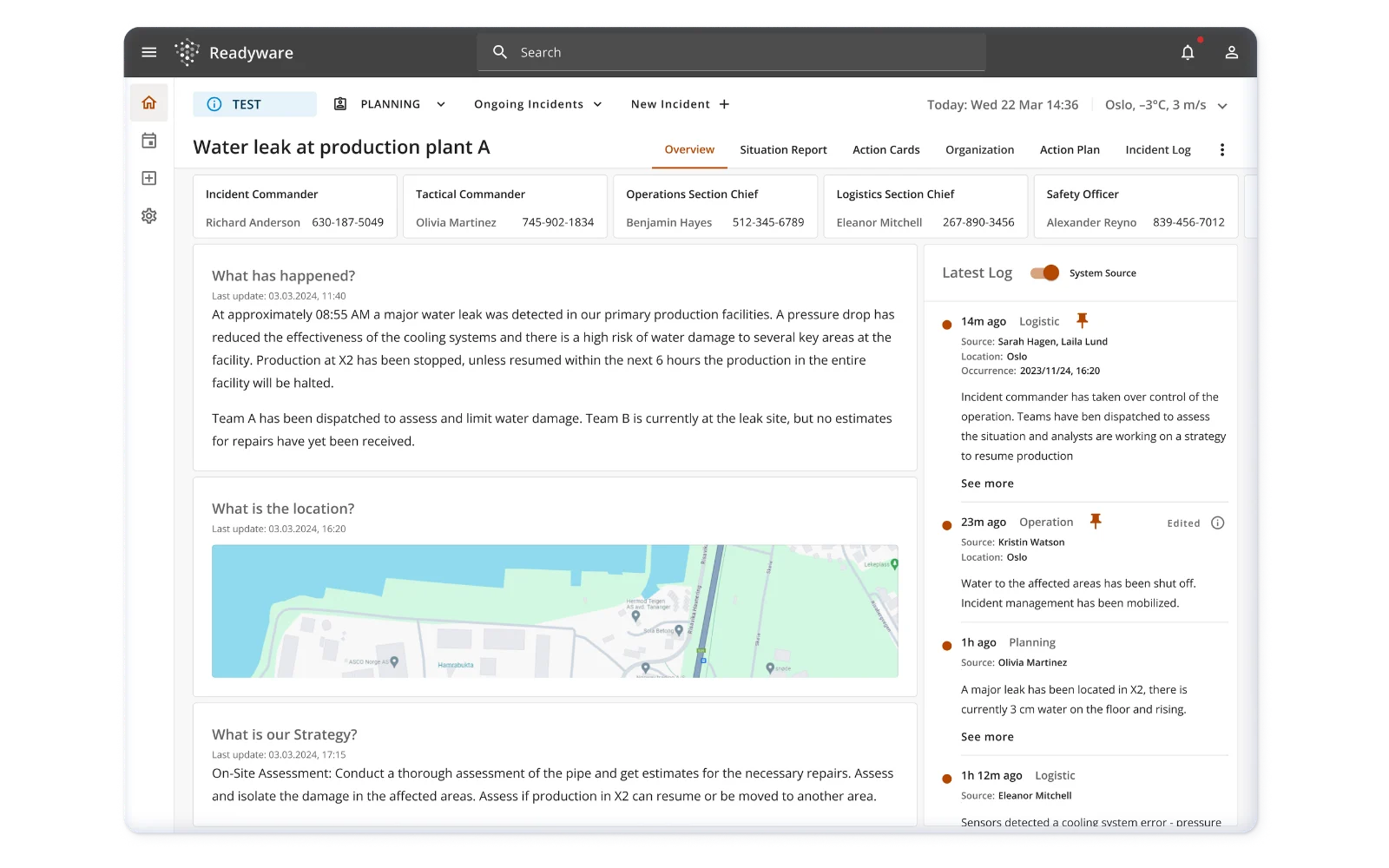
Readyware is a new add-on to Certain QMS developed precisely for this purpose. The solution digitises emergency preparedness work and transforms the preparedness plan into an operational tool that can be used both during exercises and in real incidents.

What is Readyware?

Readyware brings together emergency preparedness, continuity planning and the recovery of critical IT systems in one solution. Instead of navigating extensive documents, users gain access to concrete action cards showing what needs to be done, by whom and in which order.

The solution is built on three central areas:

  • Acute emergency response when an incident occurs
  • Continuity planning to ensure continued operations
  • Recovery of IT systems and technical infrastructure

Together, these provide the organisation with support throughout the entire course of an incident, from the initial response until normal operations have been restored.

Readyware

From preparedness plan to practical action

Traditional emergency preparedness plans can run to many pages of procedures. When a critical situation arises, there is rarely time to search for the right information.

Readyware therefore breaks the preparedness plan down into action cards and continuity cards that guide the emergency response team through the incident step by step. The cards can be tailored to the organisation’s own risk assessments and needs.

The solution is delivered with a range of scenarios covering common incidents such as:

  • Serious personal injury or fatality
  • Fire or explosion
  • Mass absence
  • Loss of a key person
  • Substance-related incidents
  • Cyber attacks
  • Data breaches
  • System failure

Multiple scenarios can be activated simultaneously if the incident develops and affects several parts of the organisation.

Support in all phases of an incident

When an incident is registered, relevant action cards are activated automatically. Actions can be documented continuously with timestamps, giving the organisation a running log of decisions and activities.

Readyware also supports role-based crisis management. Members of the emergency response team gain access to the tasks defined for their role, whilst contact information, notification routines and other key resources are readily accessible.

The solution has been developed with the understanding that critical incidents can also affect the organisation’s own systems. Provision has therefore been made for emergency preparedness work to continue even when the organisation’s ordinary network is unavailable.

Ensuring continuity when it matters

Once the acute phase has been managed, the next challenge is maintaining the organisation’s operations.

Readyware helps the organisation plan how critical functions are to be continued. This includes, amongst other things, prioritising critical systems, evaluating alternative operating modes, managing supplier dependencies and planning the recovery of IT systems in the correct sequence.

This link between emergency preparedness and continuity means the organisation can more quickly reduce the consequences of an incident and return to normal operations.

Simpler and more effective emergency exercises

Regular exercises are an important prerequisite for good emergency preparedness, but many organisations find that exercises require considerable planning and follow-up.

Readyware therefore has a dedicated exercise mode that makes it easier to plan, carry out and evaluate emergency exercises. Exercises can be managed manually or supported by artificial intelligence, which can, amongst other things, function as an exercise director, observer or sparring partner. It is also possible to add new scenarios during the exercise to test how the emergency response team handles complex incidents.

All documentation happens continuously, and the report is generated automatically with timestamped decisions, non-conformities and learning points. This reduces the need for post-exercise work and makes it easier to follow up on improvement actions.

Full overview of emergency preparedness

Readyware brings planning, execution and follow-up together in one dashboard. Here, the organisation can log incidents, initiate exercises, manage emergency response teams, monitor the status of scenarios, evaluate completed exercises and generate reports. The solution can also be linked to relevant legislation, regulations and internal requirements, giving the organisation better oversight of its overall emergency preparedness work.

An emergency preparedness plan is an important starting point, but it only creates value when actively used. By bringing action cards, continuity planning, documentation and exercises together in Certain QMS, Readyware gives the organisation a tool that makes emergency preparedness easier to plan, carry out and improve over time. The result is more operational preparedness and stronger preparedness capability.

Geir Piel

Geir Piel

Senior Business Consultant

Geir Piel is a Senior Business Consultant for Certain QMS with extensive experience in leading roles within quality, HSE and QHSE. With a background spanning operational roles, advisory services and business development, he supports organisations in translating requirements and objectives into practical quality and improvement work.

Process orientation in practice: how to build a smarter organisation

Process orientation in practice: how to build a smarter organisation

Process orientation in practice

Many organisations recognise the same challenges. Important knowledge often resides with individual people, responsibilities can be unclear, working methods vary, and leadership lacks full visibility. These are frequently signs that the organisation lacks clear process orientation.

Process orientation is not about producing more documentation. It is about creating better flow in the work, clarifying responsibilities and laying the groundwork for continual improvement.

When organisations work in a more process-oriented way, they typically become less vulnerable, more efficient and better equipped for growth and long-term organisational development.

What is process orientation?

Process orientation is about viewing the organisation as a whole made up of work processes that create value for the customer. Work is governed by how tasks flow through the organisation, not simply by departments, roles or systems.

When an organisation works in a process-oriented way, responsibility follows the process from start to finish. Working methods become standardised, processes are kept alive and developed continuously, and improvement becomes a natural part of the culture.

This is an important distinction. Many believe process orientation is a project carried out once, when in reality it is about long-term process management. In practice, it is a management model and a way of working that must be sustained over time.

What is the cost of not having control over your processes?

A lack of process orientation can have significant consequences, both operationally and strategically. There are several typical situations that commonly arise when processes are not clearly defined.

A key person leaves

When important knowledge exists only in one person’s head, the organisation becomes vulnerable. When that person leaves, much of the understanding of how the work is actually carried out goes with them. The consequence is often considerable lost time, inefficient onboarding and a high risk of errors.

Nobody knows who owns what

When responsibilities are unclear, tasks are left unattended. Customers wait, internal clarifications take time and follow-up does not happen. This can cause frustration both internally and externally. In the worst case, customers may be lost.

Everyone does things their own way

Different working methods produce different levels of quality. This can work in the short term, but it makes the organisation unpredictable and difficult to improve. Standardisation is essential for ensuring quality.

Leadership lacks visibility

Without visible processes, it becomes difficult to understand how work is actually carried out. Decisions are made on gut feeling rather than facts. This makes the organisation less robust.

Process orientation in practice

Example: when process failures have serious consequences

A clear example of how critical good processes are can be found in healthcare.

In the period 2016–2017, 3,557 medication errors were reported in Norwegian hospitals, and 62 per cent of these resulted in harm to patients. Some cases had serious consequences, including fatalities.

The cause is linked to unclear, inconsistent or inadequate processes. The point here is important. Errors do not necessarily occur because people are careless. They often occur due to a lack of process orientation.

This applies not only to healthcare. In every industry, poor processes can cost money, quality, trust and in the worst case — lives.

Example: when process orientation works in practice

One of the most well-known examples of successful process orientation is Toyota.

When Toyota took over a former General Motors factory in the 1980s, they used many of the same employees, in the same facilities, but with a completely different working methodology.

The results were dramatic. Absenteeism fell from around 20 per cent to 2 per cent. Quality improved significantly, and lead times were drastically reduced.

The difference did not lie in new technology or more staff. It lay in standardised processes, clear responsibilities and a culture of continual improvement.

This is the essence of process orientation.

Documents are not the same as processes

Many organisations have extensive documentation but still lack good processes.

Documents and processes serve different purposes. Documents are static. They must be read, interpreted and understood. Processes are visual and give a faster overview of who does what, when and how.

This is particularly important in onboarding, training and cross-functional collaboration, where clarity and accessibility are essential.

Documents still play an important role, particularly in quality management, but they should support processes, not replace them.

In short, it is about letting the process come first, with documents serving as support where needed.

The benefits of working in a process-oriented way

Organisations that succeed with process orientation often experience several concrete benefits.

They become less vulnerable to absence and staff turnover. They reduce errors and non-conformities. They create more consistent quality. They gain a better foundation for process improvement and can work more systematically to optimise workflow. And they become more scalable as the organisation grows.

For management, this means a better basis for decision-making and less time spent on non-conformities and fire-fighting.

For employees, it means less uncertainty, clearer responsibilities and a simpler working day.

For customers, it means better quality and more predictable delivery.

What does it take to succeed with process orientation?

Process orientation requires more than drawing up a process map.

To succeed, four fundamental building blocks must be in place: management commitment, clear process ownership, sound process mapping that makes processes visible, and continual improvement.

These four elements must work together.

Perhaps most important of all is culture. To succeed, processes must be actively used, owned by the organisation and improved over time.

This is not a one-off project. It is a long-term journey of change that often takes several years.

Process orientation in practice

Where does one start with process orientation?

The most important thing is to begin.

A good first step is to identify one critical process in the organisation and ask a few straightforward questions. Is responsibility clear? Is the workflow visible? Does everyone work in the same way? Do we know where the bottlenecks are?

The answers often provide an honest picture of how mature the organisation is, and where the greatest potential for improvement lies.

Process orientation is not about changing everything at once. It is about creating clarity, building good working habits and laying the foundation for continual improvement.

The earlier you start, the sooner the organisation can reduce vulnerability, strengthen quality and build a more robust and efficient operation.

Audhild Smith-Bergtun

Audhild Smith-Bergtun

Business Consultant

Audhild Smith-Bergtun is a Business Consultant at Netpower and works with the implementation and further development of quality and HSE work in Certain QMS. With experience from several QHSE roles in the oil and gas industry, she supports organisations with advisory services in compliance, processes and system support.

Information security management system

Information security management system

Informasjonssikkerhet

Certain QMS is a fully-featured quality management system with functionality for management processes, documentation, risk assessment, audit and more. The system also meets the requirements for an organisation-wide information security management system (ISMS).

This means that organisations can use Certain QMS to establish, follow up and document information security in a structured and transparent manner, without additional software or separate ISMS tools.

This article explains how you can use Certain QMS to establish and manage a complete ISMS. We walk through the relevant features of the system and describe what is included in terms of ready-made templates, supporting documentation and tools in our ISMS package.

Certain QMS: a comprehensive ISMS tool

Certain QMS supports the entire lifecycle of information security work, from establishment through to continual improvement, and is suited both to organisations seeking ISO 27001 certification and to those wanting a structured ISMS without formal certification.

The system gives you the tools you need to:

  • Establish an ISMS: Access ready-made procedures, policies and process models that can be adapted to your organisation.
  • Plan and follow up: Use the annual planner functionality to plan activities and tasks, assign responsibilities and ensure that tasks are completed and documented.
  • Assess risk: The risk module provides an overview and control, making it straightforward to follow up on actions.
  • Manage data protection: The DPIA process supports the assessment of high-risk processing activities, and is linked to risk assessment and actions.
  • Ensure compliance: The compliance module helps you document that requirements from legislation, standards and customers are being met.
  • Document processing activities: The records of processing activities provide an overview of the organisation’s personal data processing, functioning as an integrated part of the ISMS.

What is an ISMS?

An information security management system (ISMS) is a framework that helps organisations protect information systematically. It provides structure for how risks are identified, controls are put in place, security measures are documented and follow-up is carried out over time.

The main objectives of an ISMS:

  • Information should always be confidential, accurate and available to those who need it
  • Compliance with legal requirements, standards and internal guidelines

In the same way as a quality management system (QMS), an ISMS combines processes, routines, policies and documentation to give the organisation a clear framework.

An ISMS makes it possible to:

  • Assess and manage risks relating to information
  • Ensure that actions are followed up and documented
  • Clarify roles and responsibilities for security
  • Document compliance with standards and legal requirements
  • Continually improve information security

By using Certain QMS as an ISMS, the organisation has all the necessary tools in one place — from document control and risk assessment to checklists, processes and audit — making implementation and follow-up clear and cohesive.

Why is an ISMS important for the organisation?

An ISMS gives management a systematic framework for documenting and following up that the organisation complies with legislation, regulations and both internal and external requirements relating to information security and data protection.

The main reasons for having an ISMS:

  • Legislation and regulation: An ISMS makes it possible to document that the organisation complies with applicable laws and regulations, such as the Personal Data Act / GDPR and the NIS2 Directive for critical infrastructure, or sector-specific requirements.
  • Standards and certifications: ISO 27001 and other international standards set requirements for the management of information security, and an ISMS provides a documented basis for compliance and any certifications.
  • Customer expectations: More customers require their suppliers to manage information security systematically, and an ISMS provides documentation of this.
  • Risk and vulnerability management: The system makes it possible to identify and manage risks relating to information, whilst follow-up and control are documented.
  • Continual improvement: By establishing a systematic framework, the organisation can follow up on actions, document results and continuously improve its security level.

With an ISMS, organisations can demonstrate to both regulators and customers that they take information security seriously.

A process-oriented approach to ISMS

Certain QMS supports a process-oriented approach to management, meaning that information security work is organised around processes rather than functions or departments.

Information security work is established as a dedicated process area in which both main processes and sub-processes are modelled. This makes it easier to see the full picture of the work and where responsibility lies.

Documentation linked to processes

All documentation (procedures, guides, instructions, templates and more) is linked to the relevant activities in the process, and is also logically organised within a dedicated folder area for information security. Users can navigate via the processes or the folder structure.

All documents have full version control, and both documents and processes can be managed with role-based access, so that only authorised users see relevant content.

Annual planner for information security work

Certain QMS supports a process-oriented approach to management, meaning that information security work is organised around processes rather than functions or departments.

Information security work is established as a dedicated process area in which both main processes and sub-processes are modelled. This makes it easier to see the full picture of the work and where responsibility lies.

Annual planner for ISMS establishment

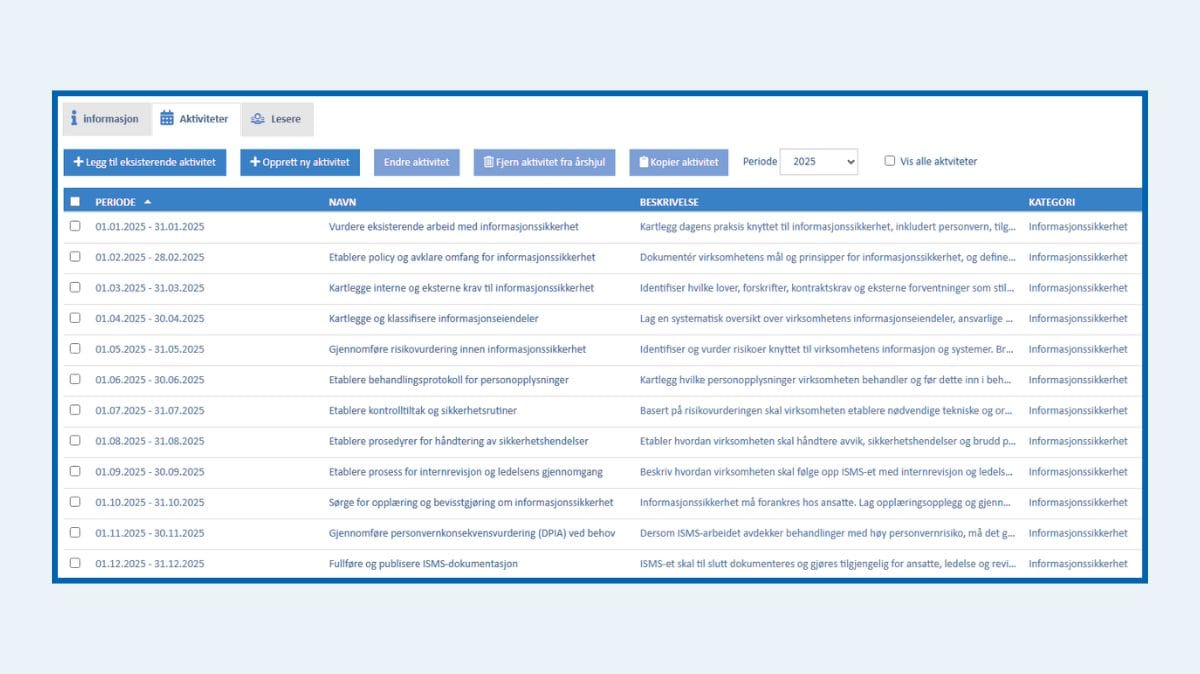
The annual planner for ISMS establishment helps you carry out the initial setup work in a structured manner, ensuring that the ISMS is established correctly from the outset.

Contents:

  • 12-month structured plan
  • Activities with clear guidance text and tasks
  • Green status shown when tasks are completed

Examples of activities throughout the year:

  • January: Map existing security work
  • May: Carry out risk assessment
  • July: Establish controls and security routines
  • December: Complete and publish the ISMS
Årshjul etablering av ISMS Certain QMS

Annual planner for ISMS establishment.

Annual planner for continual improvement

Once the ISMS has been established, the system must be kept active. This annual planner provides a template for annual maintenance, follow-up and improvement.

Activities include:

  • Revision of previous risk assessments
  • Internal audit and management review
  • Training and awareness-raising
  • Review of the records of processing activities and DPIA requirements

Ready-made document templates for ISMS

Certain QMS can be delivered with a complete template set for ISMS, giving the organisation a solid starting point for documenting and following up on information security.

The templates are designed to be adapted to the individual organisation, whilst ensuring that all necessary elements are in place.

The template set covers:

  • ISMS policy
  • All necessary procedures, including incident management, access control and operations
  • DPIA procedure and templates
  • Audit plan and audit report
  • Management review

The document templates include:

  • Field lists with guidance text to assist the user
  • Established content templates that can be inserted into documents where relevant

DPIA support in Certain QMS

A DPIA (Data Protection Impact Assessment) is an assessment of how a personal data processing activity may affect individuals’ rights and freedoms. Carrying out a DPIA is required when processing is likely to result in a high risk to data subjects.

Certain QMS supports the entire DPIA process by combining checklists, document templates and risk assessment.

How the system supports DPIA work:

  • Checklist for assessing the need for a DPIA
  • Guidance for assessment in line with the Norwegian Data Protection Authority
  • Risk analysis template for carrying out a DPIA
  • Request function for risk analysis
  • Incident register for data protection risk
  • Dedicated impact areas for data protection rights, confidentiality, availability, integrity, reputation, legal requirements and regulations

Risk analysis request

In Certain QMS, users can submit a request for a risk analysis directly within the system. This enables the data protection officer, information security officer or other relevant roles to receive notification that an analysis of a system or process needs to be carried out.

The feature ensures clear accountability and efficient follow-up, without requiring everyone involved in DPIA or process work to carry out the analysis themselves.

DPIA document template

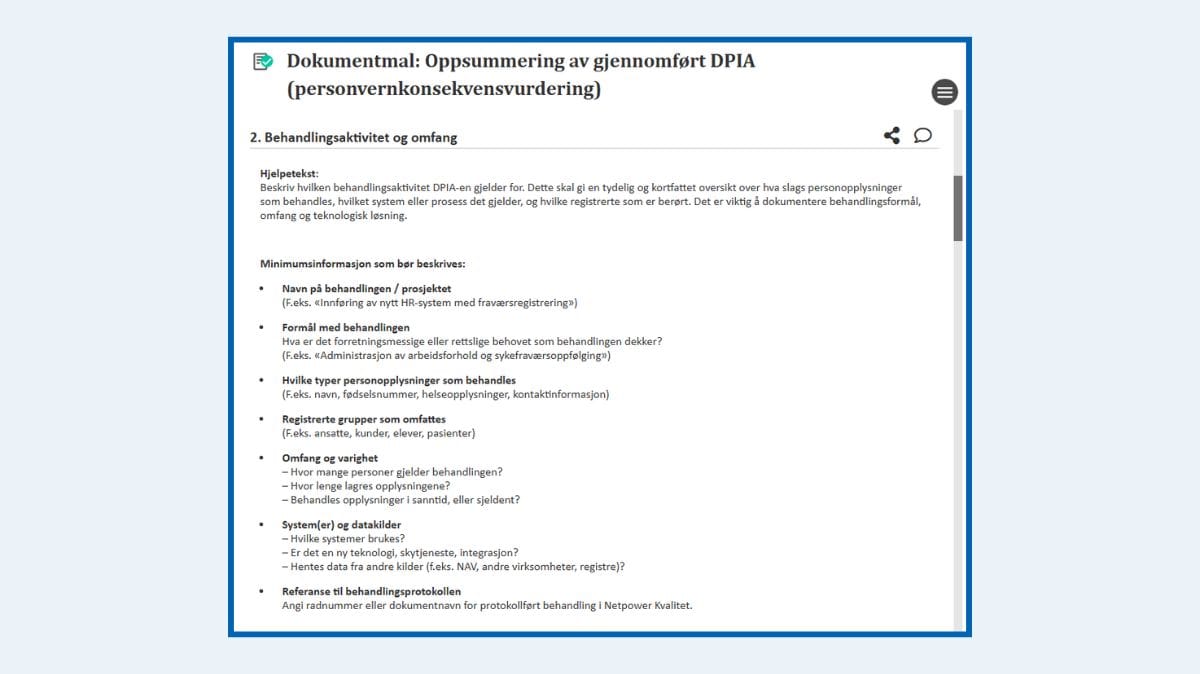
Once a DPIA has been completed, the results can be documented using a dedicated DPIA template in Certain QMS. The template helps you systematically summarise the purpose, processing activity, assessed risk, actions and conclusion. Built-in guidance text and a clear structure ensure that all relevant elements are covered, even for users without specialist data protection expertise.

The document can be linked directly to the records of processing activities, and serves as the organisation’s documented evidence that the assessment has been carried out in accordance with GDPR Article 35. The DPIA documentation can be used in management reviews, internal controls or external audits, and ensures both traceability and compliance.

Dokumentmal oppsummering gjennomført DPIA Certain QMS

Document template for summarising a completed DPIA.

Systematic risk work for information security

Certain QMS offers a tool that covers the entire risk management process, from planning through to follow-up:

  • Planning
  • Risk analysis
  • Risk evaluation
  • Risk management

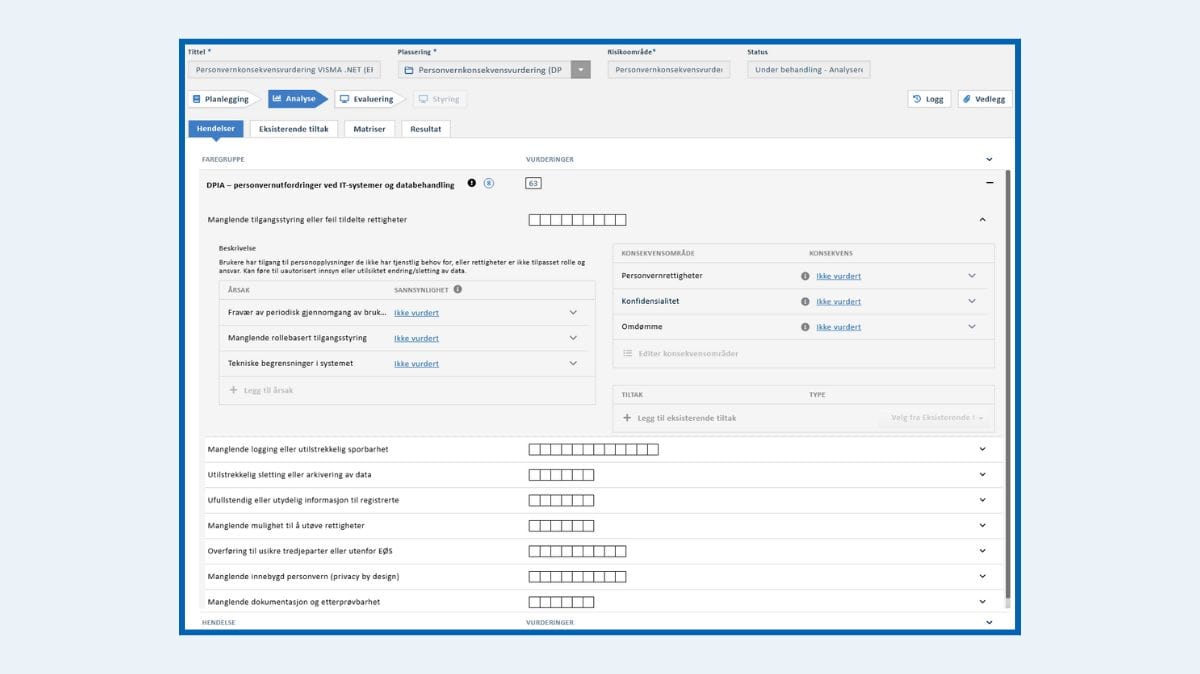
Within the solution, information security is configured as a dedicated risk area. The analysis is delivered with a pre-configured template that includes relevant impact areas, acceptance levels and predefined events to be assessed. The predefined event register streamlines the work for the analysis team, enabling them to focus on assessing and prioritising risks rather than starting from a blank page when identifying potential threats.

All steps and fields in the analysis include extensive guidance text to guide the user through the process. The guidance text can also be adapted to the organisation, and consequence levels are described with explanatory text to support assessments.

The risk analysis template supports:

  • Predefined events, causes and actions
  • Multiple impact areas, including CIA + data protection rights
Analysemal for DPIA Certain QMS

Analysis template for DPIA.

Visual and dynamic overview of the risk landscape

Certain QMS provides a visual representation of the risk landscape through both risk matrices and table views. This makes it straightforward to understand and communicate which threats have been assessed as most critical, and which actions have been put in place.

The solution also offers a dynamic risk report where you can filter by risk area, responsible party, department and other parameters. This gives the organisation a real-time reflection of the actual risk landscape, based on which analyses have been carried out and assessed.


The report makes it possible to:

  • View aggregated risk within areas such as information security, data protection or ICT operations
  • Identify risks that lack actions or have a high residual uncertainty
  • Give management an up-to-date and documented overview of the organisation’s risk profile

This supports systematic follow-up, simplifies audits and ensures that risk work is embedded and visible across the organisation.

Risk management with actions and action plan

Once the risk analysis has been completed, an action plan is drawn up to reduce the risks associated with information security. The action plan forms the basis for risk management, with the risk owner taking responsibility for follow-up.

In Certain QMS, all of this can be handled directly within the solution, and tasks to be carried out can be assigned from the tool.

In the management phase, the risk owner can:

  • Prioritise actions for implementation
  • Accept residual risk
  • Delegate responsibility for implementing actions
  • Set deadlines for actions and follow-up
  • Record costs associated with implementation
  • Monitor the status and progress of each action

Risk management is concluded when the risk owner has assessed the effect of the actions implemented, signed off on the residual risk and formulated a final conclusion for the work.

Compliance register

A compliance register is an overview of requirements from legislation, standards and internal guidelines, linked to relevant documentation in the management system. In Certain QMS, the compliance register is one of many available features that helps the organisation maintain an overview and ensure compliance.

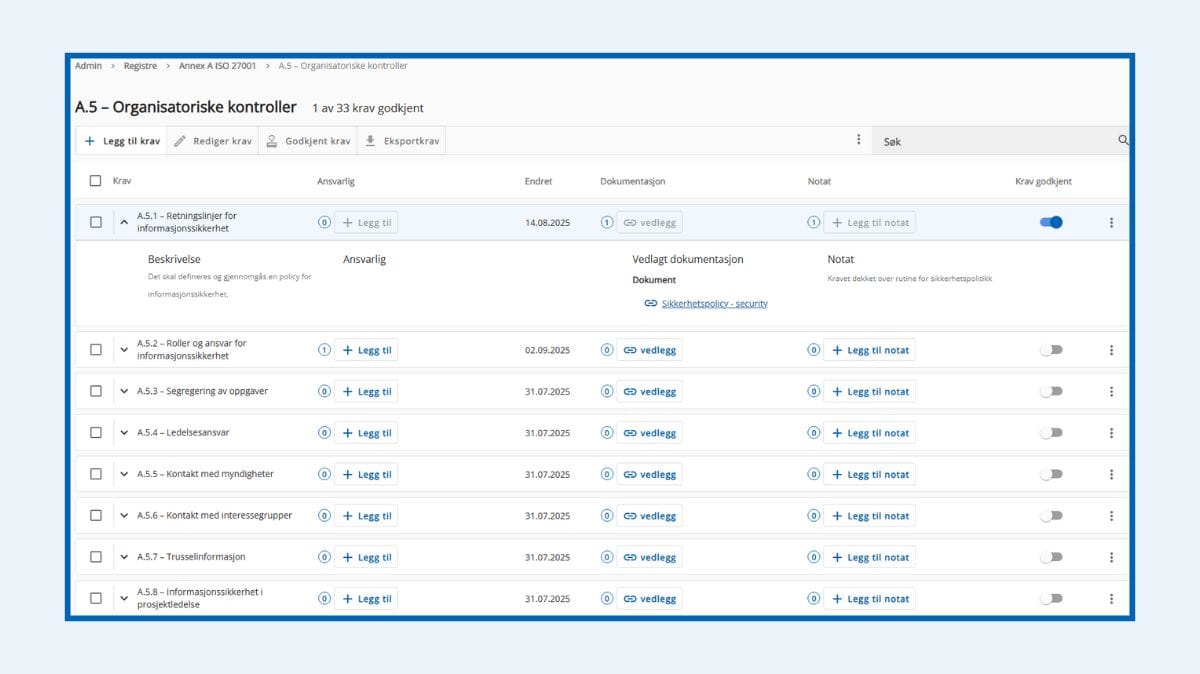
For ISO 27001 Annex A, all 93 controls are pre-registered in the system. Each control includes an explanation of what it entails and status fields indicating whether the requirement has been met. This makes it straightforward to use the register in audits, gap analyses and improvement work.

A ready-made template set for a GDPR article register can also be produced as part of the delivery.

Samsvarsregistermannex A ISO 27001

Compliance register for Annex A ISO 27001.

Records of processing activities and GDPR

Certain QMS offers a table-based document template for records of processing activities that follows the requirements of GDPR Article 30 and the Norwegian Personal Data Act. The template includes fields for the legal basis for processing, types of personal data, storage, security measures and other relevant information.

The documentation can also be linked to associated DPIAs and compliance assessments, giving the organisation a clear overview of all connections between processing activities, risk and legal requirements.

Follow-up and version control

As part of the work with records of processing activities, Certain QMS also supports control of the records through the annual planner for continual improvement. Version management and availability of the records of processing activities are handled directly in the document module, so that all changes and updates can be easily followed up.

Making documentation available and sharing it

Certain QMS supports the publishing of selected documents on internal or open portals. This enables employees, customers and partners to access relevant information without having to navigate the entire system.

This supports compliance by ensuring that all relevant parties always have access to correct and up-to-date documentation. In this way, requirements for compliance, training and internal control are met, whilst important processes and routines become transparent to all who need them.

Leder som følger opp informasjonssikkerhet ISMS

ISMS package for Certain QMS

Ready to install and use from day one

Our ISMS package is delivered pre-configured and installed on the customer’s own Certain QMS installation. Each package gives the organisation everything needed to establish, document and follow up an information security management system in line with ISO 27001 and GDPR:

  • ISMS documentation: procedures, policies and process models
  • Annual planner for establishment
  • Annual planner for continual improvement
  • Risk analysis templates for information security
  • DPIA support with checklists, guidance and risk templates
  • Compliance register for ISO 27001 and the option of a GDPR article register
  • Document template for records of processing activities
  • Full version control and role-based access for all documentation

The packages are ready to use from day one, but can be adapted to the organisation’s needs and existing processes.

Contact us for a demonstration and pricing.